
By Brian LeBarron | Fluidampr | Vibratech TVD
The Problem: Unstable Crankshaft Position Sensor Signal at 2,800 Horsepower
Imagine trying to tune a 2,800 horsepower high-performance Gen III HEMI engine and you can’t get reliable, consistent data off the crankshaft position sensor. Inadvertently programming a lean condition at 7,000 RPM can be catastrophic. That’s exactly the challenge Chris Baily, owner and champion drag racer at Baily’s Hyperformance in Boyd, Texas, encountered.
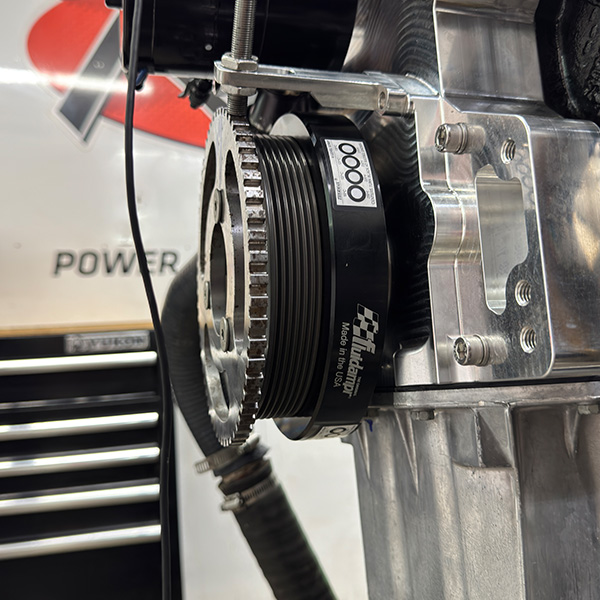
To achieve that level of power Baily’s Hyperformance developed new fully boxed-in pistons. In doing so the factory crankshaft position sensor located at the rear of the crankshaft became unusable. To solve that, they created a reluctor wheel pickup mounted to the harmonic damper. With the sensor now reading from the snout end of the crankshaft, Baily noted they were seeing RPM signal fluctuation. This is a concern because if the sensor does not receive a clean signal, the ability to develop an optimum tune is compromised. They suspected the cause was excessive crankshaft torsional vibration.
Why Crankshaft Torsional Vibration Affects Sensor Accuracy
Torsional vibration is different from rotational vibration and balancing. Torsional vibration is the end-to-end twisting and rebounding of the crankshaft caused by combustion. Each time a cylinder fires the downward force of the connecting rod against the crank journal causes it to flex ahead of its natural rotation, and then it rebounds back like a spring. Across all cylinders and throughout the RPM range, torsional vibration sets up what is commonly referred to as engine harmonics.
Crankshaft torsional vibration consists of frequency and amplitude, with resonance occurring at critical operating speeds. If the amplitude is great enough it can corrupt data input and can lead to an inaccurate tune, or code errors. In extreme cases, it can result in costly engine failure. If left uncontrolled, torsional vibration will accelerate wear on many other critical engine components.
To solve the problem, Baily suspected he first needed to reduce the crankshaft torsional vibration occurring throughout the RPM range. But how? Enter Vibratech TVD, the parent division of Fluidampr performance dampers. Vibratech TVD has provided crankshaft torsional vibration analysis and harmonic damper development for over eight decades to some of the most iconic OEM automotive, marine, commercial and industrial brands in the world, plus defense applications. He reached out with the simple request to build a better harmonic damper.
Engineering a Harmonic Damper for the Gen III HEMI
Vibratech TVD begins each project by understanding the client’s needs, operating environment, and long-term objectives. The engineering team then proceeds with a thorough study of the design envelope, airflow conditions, and auxiliary needs.
Recognizing the popularity of naturally aspirated Gen III HEMI engines throughout the performance racing industry and automotive aftermarket, it was also easy to determine that this damper would be destined for the Fluidampr catalog. It would be made available through distribution and retail sales channels.
Knowing it was headed to the consumer market and could be used in top-tier professional motorsports, engineers determined that this Fluidampr performance damper needed to use a viscous design capable of optimum damping under high torque loads across a broad RPM range. It also needed a product life longer than that of the engine while requiring no maintenance. Finally, it needed to meet SFI 18.1 spec requirements for safety approval in professional motorsports. The Fluidampr performance viscous damper design has been used in professional motorsports and OEM applications for decades, providing a proven foundation for the project.
A Fluidampr performance damper viscous design incorporates an inertia ring inside a sealed outer housing. A thin layer of viscous silicone is then pressure injected between the two in an area known as the shear gap. As the crankshaft twists and rebounds the relative movement of the inertia ring shearing through the silicone transforms torsional vibration to heat. Heat then safely radiates out the housing.
Engineers also needed to factor in the nature of the aftermarket and to address how the damper integrates with a wide range of unknown engine configurations. The first consideration was pulley flexibility, including replaceable underdrive options to reduce the risk of coolant cavitation and alternator overspeed during sustained high-RPM operation. In addition, provisions to mount a mandrel drive for a dry-sump oil system and/or a centrifugal supercharger were also needed.
Using crankshaft geometry, firing order, operating RPM range, and accessory drive requirements, Vibratech TVD engineers established the torsional vibration characteristics that the damper would need to control. Multiple design variables, including inertia ring properties, silicone viscosity, and thermal management considerations, were evaluated before prototype testing began.
While viscous dampers are widely used in industrial and commercial applications, variables such as cooling, inertia ring design and properties, and strategic materials can all be adjusted to make them very effective for high-performance, high-RPM automotive use. Vibratech TVD viscous dampers are currently used on several of today’s leading OEM hypercars.
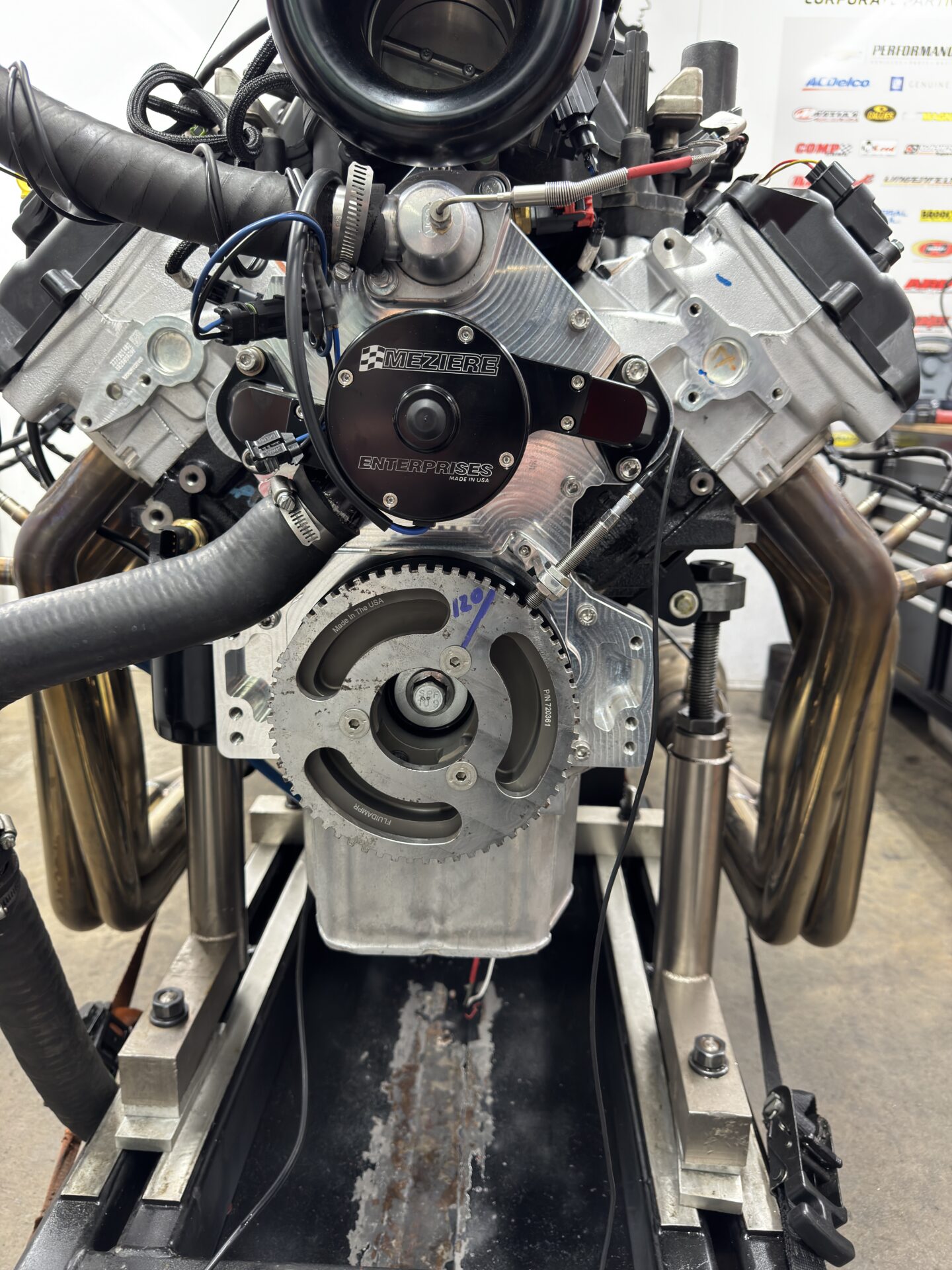
Torsional vibration validation testing was conducted by Vibratech TVD to OEM methods at Scoggin-Dickey Parts Center Raceshop in Lubbock, Texas. A mildly modified 5.7L Gen III HEMI was used to compare multiple Fluidampr prototypes, plus competitive products.
How the Damper Was Tested
To test the prototypes and comparable products, the teams at Vibratech TVD and Baily’s Hyperformance traveled to Scoggin-Dickey Part Center Raceshop in Lubbock, Texas in May 2026. There they met up with SDPC’s Gordon Paden and John Alonzo III for a day on the engine dyno. On the stand was their development Gen III 5.7L HEMI with a camshaft upgrade and Smith Innovation timing cover allowing for a Big Block Chevy water pump to be mounted.
To get accurate measurements, a gear tooth sensor was mounted to the front of the damper. In addition, a wire harness split was added to the crank position sensor at the rear of the crankshaft to capture the total end-to-end deflection. Both were fed into a Fast Fourier Transform (FFT) analyzer to capture thousands of measurement data points per second.
With the test recording equipment in place, the professional dyno operator made two consistent passes for each test damper at a rate of 300 RPM per second to improve repeatability and provide redundant data.
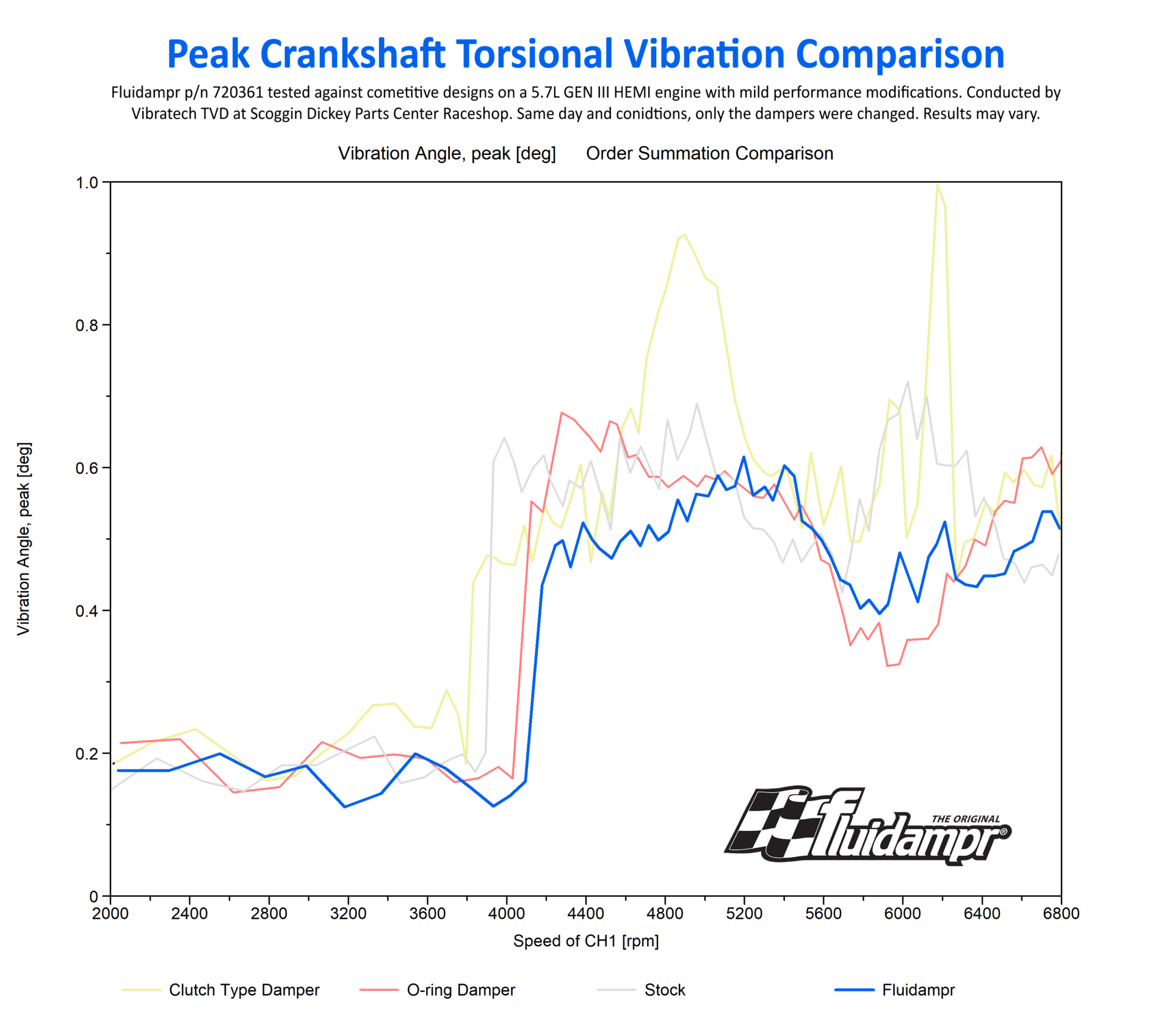
Dyno Results: Measuring Torsional Vibration Reduction
The following chart shows a 10-order summation comparison of peak crankshaft twist across the RPM range, measured at the damper sensor. The dampers tested were a new stock elastomer style, new performance O-ring style damper, the current development engine’s clutch type, and the final selected Fluidampr prototype.
Regarding total end-to-end crankshaft deflection reduction, on average across the RPM range Fluidampr reduced it:
- 8% over stock elastomer damper tested.
- 4% over O-ring style damper tested.
- 13% over the clutch type damper tested.
“Seeing firsthand the level of analysis involved in measuring crankshaft harmonics, damper performance, and the specialized equipment required for this type of testing was extremely impressive,” Paden remarks. “Testing of this caliber is critical for improving durability, reliability, and overall engine performance, which is exactly what we’re all about at Scoggin Dickey Parts Center.”

Source: Baily’s Hyperformance
“At higher RPM, our previous setup would experience fluctuations of approximately 100-200 RPM, making the data inconsistent. After switching to Fluidampr, the RPM signal returned to factory-like stability, allowing for more accurate tuning.”
Chris Baily, Owner | Baily’s Hyperformance
Track Validation: Did It Improve Real-World Performance?
Any race team will tell you there’s a world of difference between a dyno room test and the track. For that, Baily installed the Fluidampr performance damper on their own record-setting, 426ci twin-turbo powered 2018 Dodge Demon drag car. Could Baily’s Hyperformance improve their tune, especially at high RPM where torsional vibration was worse? Could the Fluidampr construction survive 2,000 lb-ft of torque and 2,800 horsepower the car lays down pass after pass?
“As someone who is constantly pushing the limits of the Gen III HEMI platform, we’re always looking for products that solve real-world problems while creating opportunities for racers and builders,” Baily says.
With several months and passes on the books, track feedback has been a success. “The crank signal improved dramatically,” Baily noted. “The signal is now clean, stable and predictable. At higher RPM, our previous setup would experience fluctuations of approximately 100 to 200 RPM, making the data inconsistent. After switching to Fluidampr, the RPM signal returned to factory-like stability with no erratic jumps, allowing for more accurate tuning.”
Data consistency is key in high-performance late-model drag racing. “The improved crank signal allows us to confidently use our RPM-based control strategies again. More importantly, it gave us consistent, repeatable data, which is critical when tuning and racing at this level,” Baily continues. “Having reliable engine data translates directly into more confidence in the tune and more consistency at the track.”
Builder Perspective
Race engine builders are natural problem solvers. Troubleshooting and scientific methods are commonly applied to overcome challenges. Often, the solution can be surprising. “What surprised me most was that the harmonic issues we had been chasing with other dampers were actually resolved. The testing and engineering support from Fluidampr and Vibratech TVD confirmed what I had suspected. Harmonics were negatively affecting our crank signal and engine data. Fluidampr and Vibratech TVD’s technology truly made a measurable difference,” Baily states.
“What also stands out to me is the flexibility,” Baily remarks. “The ability to easily configure different overdrive and underdrive ratios gives builders more options to tailor their combination, while the crank trigger capability opens the door for advanced ECU strategies and standalone engine management solutions.” That’s important as more racers continue to grow beyond traditional setups.
Baily concludes, “It’s clear this wasn’t just designed as another pulley. It was engineered with future growth and adaptability in mind. We’re excited to see manufacturers like Fluidampr continue to invest in the Gen III HEMI community and provide products that help racers and performance enthusiasts take their builds to the next level.”
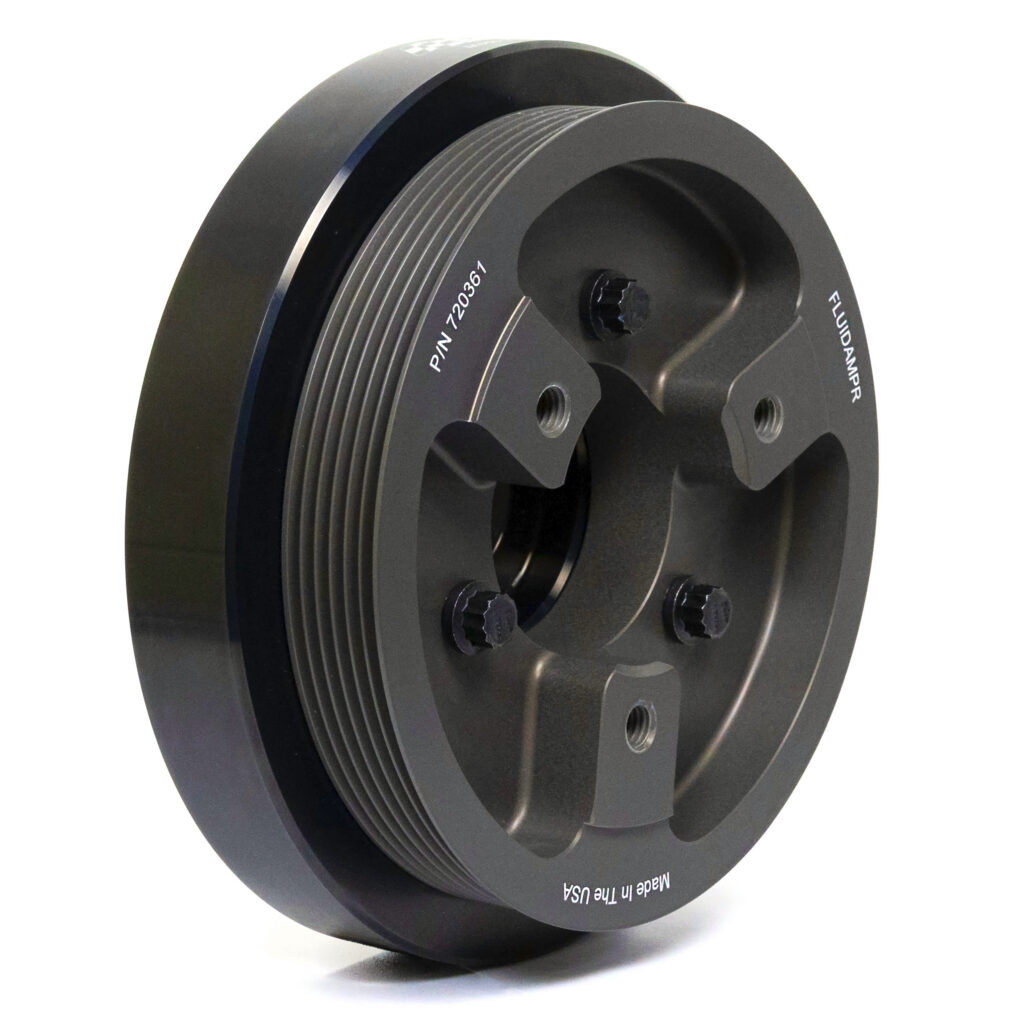
From Prototype To Production
Production of Fluidampr performance dampers follows the same ISO 9001:2015 quality systems certified process as Vibratech TVD OEM and Tier 1 supplier standards. The semi-automated advanced manufacturing process supports high-volume precision and consistent cycle times, with statistical process control and lot traceability. To maintain their appearance in a rigorous motorsports environment the dampers are finished in a RoHS approved, corrosion resistant black zinc with laser-engraved markings. Finally, industry-standard ACES and PIES catalog data is created for each part number, providing accurate fitment information, product specifications, and digital assets across distributors, retailers, installers, and online marketplaces.
Ultimately, the project is about helping race engine builders and the performance racing industry. “I was equally impressed by the Fluidampr and Vibratech TVD team’s attention to detail and willingness to listen. It’s not often you see a company of their size take the time to understand the needs of a niche market, work through the problem, and deliver a solution. That level of customer support speaks volumes and I truly appreciate the opportunity to work with them,” Baily concludes.
Contact
From close collaboration with motorsports innovators to aftermarket catalog production, Fluidampr, and parent company Vibratech TVD are your turnkey harmonic damper development partners. Call (716) 592-1000 or visit VibratechTVD.com for expert consultation.
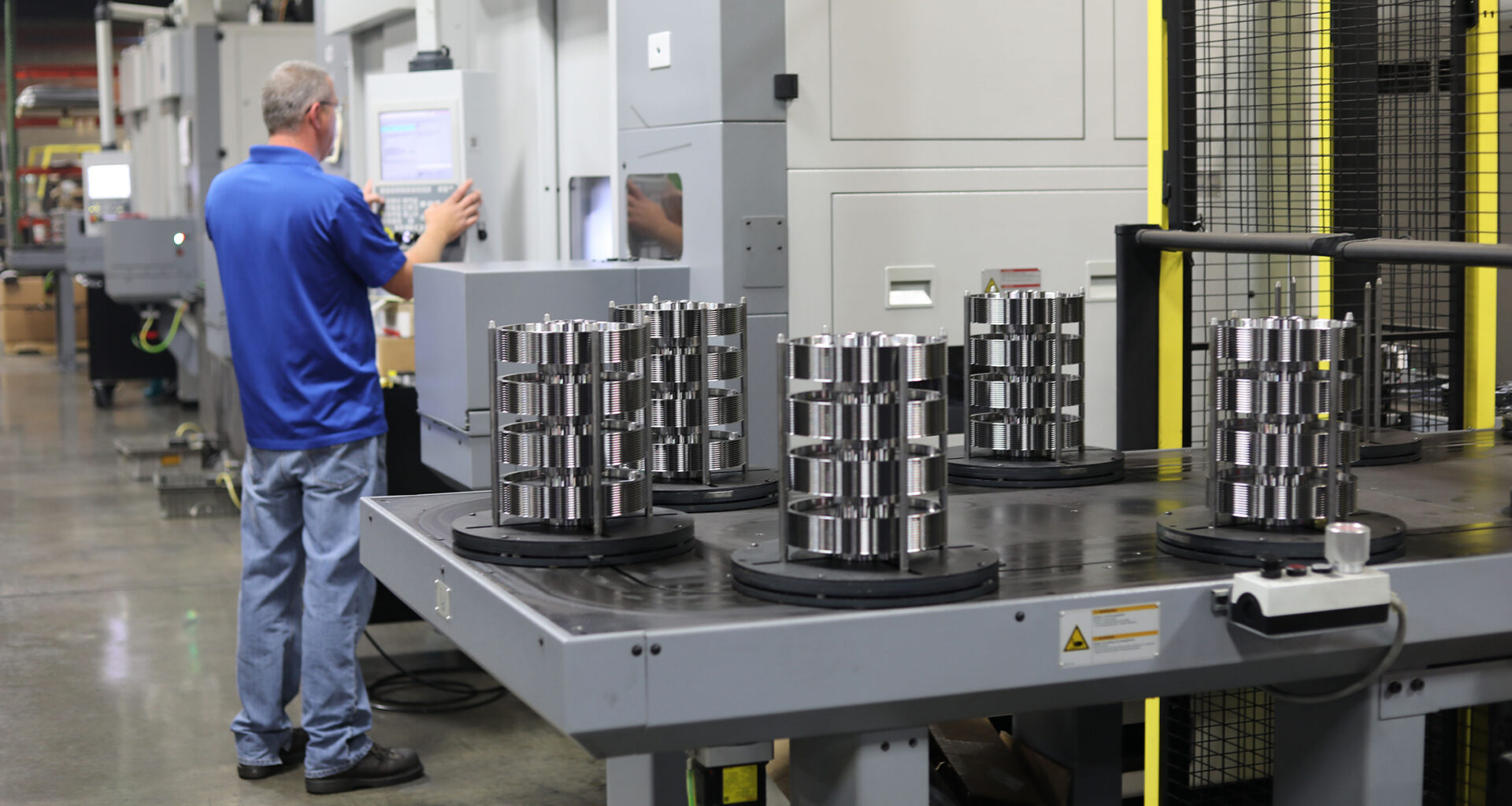
Vibratech TVD and Fluidampr high volume EMAG machining center. All damper engineering, machining, and final assembly is located in Springville, New York.
Engine Builder Notes
Application
Designed for naturally aspirated Gen III HEMI car and SUV engines. Verify engine application and accessory drive configuration before installation.
Installation Hardware
Always follow the recommended crankshaft bolt and torque procedure. Replace any torque-to-yield (TTY) hardware if specified by the OEM.
Keyway or Pinning?
The factory keyway is suitable for most naturally aspirated applications. High boost, nitrous, or extreme horsepower combinations may benefit from additional crankshaft pinning.
Crank Trigger Compatibility
Three pre-drilled 3/8-16 UNC 28 bolt holes on a 3.20” bolt circle support crank trigger applications and standalone engine management systems requiring front-mounted engine speed sensing.
Accessory Drive Flexibility
Removable stock size 6-3/8” pulley allows builders to optimize accessory speed for sustained high-RPM operation while reducing the risk of alternator overspeed and coolant cavitation.
Future Upgrade Ready
Three pre-drilled 3/8-16 UNC 28 bolt holes on a 3.20” bolt circle provide mandrel drive provision support dry sump oil pumps and centrifugal supercharger drives, allowing future engine upgrades without replacing the damper.
Designed for High RPM
The viscous damper design provides effective torsional vibration control across a broad operating RPM range without routine maintenance.
Professional Motorsports Approved
Engineered to meet SFI 18.1 specifications for use in professional motorsports applications.
Damper Installation
Never install the damper by drawing it onto the crankshaft with the retaining bolt. Use the proper installation tool to prevent thread damage and ensure the damper is fully seated.
Engine Balance
Designed for the factory crankshaft balance configuration. Always verify the correct balance specification and application before installation. Never interchange dampers between internally and externally balanced engine families.
Frequently Asked Questions
What is crankshaft torsional vibration?
Crankshaft torsional vibration is the twisting and rebounding motion of the crankshaft caused by combustion forces. Unlike rotational imbalance, torsional vibration occurs along the length of the crankshaft as each cylinder fires. If left uncontrolled, it can contribute to inaccurate sensor readings, accelerated component wear, reduced reliability, and in severe cases, crankshaft failure.
Can crankshaft torsional vibration affect crankshaft position sensor accuracy?
Yes. Excessive crankshaft torsional vibration can create fluctuations in crankshaft position sensor signals, particularly in high horsepower applications where sensor accuracy is critical. Cleaner, more consistent sensor data allows the engine management system to make more accurate fueling and ignition decisions during tuning.
Does balancing eliminate torsional vibration?
No. Engine balancing reduces rotating and reciprocating mass imbalance, while torsional vibration is a separate dynamic caused by combustion forces twisting the crankshaft. A well-balanced engine can still experience significant torsional vibration that requires a properly engineered harmonic damper.
How does a viscous harmonic damper reduce torsional vibration?
A Fluidampr viscous harmonic damper uses a free-floating inertia ring suspended in a thin layer of silicone inside a sealed housing. As the crankshaft twists and rebounds, the inertia ring shears through the silicone, converting harmful torsional vibration into heat that safely dissipates through the damper housing.
Why can torsional vibration become a problem at high RPM?
As engine speed increases, combustion events occur more frequently and resonance can develop at certain operating ranges. Higher cylinder pressure, greater horsepower, and sustained engine speed can increase crankshaft twist, making effective torsional vibration control increasingly important in performance engines.
Can a harmonic damper improve engine tuning?
While a harmonic damper does not directly increase horsepower, reducing crankshaft torsional vibration can provide more stable crankshaft position sensor data. For tuners relying on accurate engine speed and timing information, cleaner signals can improve confidence when calibrating ignition timing and fuel delivery.
Why did Fluidampr use a viscous damper instead of an elastomer design?
Viscous dampers provide effective torsional vibration control across a broad RPM range without relying on tuned rubber elements. The sealed silicone design requires no routine maintenance and has been used successfully in demanding OEM, commercial, industrial, marine, defense, and professional motorsports applications for decades.
Why are harmonic dampers important in high horsepower engines?
As horsepower and torque increase, so do the combustion forces acting on the crankshaft. A properly engineered harmonic damper helps reduce damaging torsional vibration, protecting the crankshaft and supporting reliable operation of critical engine components throughout the RPM range.
Does this Fluidampr harmonic damper support future engine upgrades?
Yes. The damper was engineered with flexibility in mind, including provisions for interchangeable pulley ratios, crank trigger capability, and mandrel drive accessories for applications such as dry sump oil systems and centrifugal superchargers. This allows builders to adapt the engine as performance goals evolve.
What makes this Gen III HEMI harmonic damper different?
The damper was developed through a collaborative engineering process that included torsional vibration analysis, prototype development, instrumented dyno testing, and real-world validation. Designed specifically for naturally aspirated Gen III HEMI car and SUV applications, it combines OEM engineering practices with the durability and adaptability expected by performance engine builders.